Cut Without Hands
What laser-cut love spoons tell us about intimacy today.

When you scroll through an endless sequence of dating profiles, you stop seeing people. You see images arranged for quick recognition. Photographs chosen for legibility. These profiles do not fail because they are dishonest. They fail because they are required to carry significance on their own, without the support of shared time, shared routines, or any obligation beyond the moment of encounter.
I felt something similar standing in a tourist shop in my own town, facing a wall of love spoons. They were aggressively uniform. Hung in neat rows, same exact shape repeated. Nothing objectionable in isolation. But together, they collapsed into pattern. Standing there, the feeling was familiar. The same thinning that appears elsewhere in contemporary life. What matters here is not whether the love spoon still means something.
The Welsh love spoon is still with us. Its shape is immediately legible. Its symbolism widely understood. But our relationality to it has morphed into something different.
Historically, the love spoon mattered because the crafting and gifting were inseparable. The spoon carried the trace of effort sustained for another person. Time was not an obstacle to meaning, it was the medium through which meaning accumulated.
The time required to carve a love spoon did more than produce meaning; it structured exposure. Delay moderated expectation. It slowed anticipation and distributed emotional risk across a process rather than concentrating it into a single moment. A relationship unfolded alongside the work, with room for uncertainty, interruption, and adjustment. The gesture did not have to carry everything at once, because it was held in place by a shared duration that preceded it.
When such delays disappear, meaning does not become weaker or less sincere. Once delay becomes optional rather than enforced, it stops functioning as a shared protection and becomes a personal preference. It becomes more exposed. What had once been absorbed gradually by process is now encountered directly, without buffer. Gestures must land immediately, and the consequences of misunderstanding or disappointment are felt more sharply because there is little else around them to take the strain. The loss we face here is not patience as a virtue, but more so delay as a form of social protection.
Today, most love spoons are bought. Some are outsourced, handmade by others. Many are mass-produced or laser-cut. So the making itself still exists, but with the current management of avoiding participation. For most people, entry to the tradition begins and ends with purchase.
What is lost through is process is not meaning, rather how we relate and our orientation to the spoon. When the object arrives complete, the time that once structured the exchange is absent, due to displaced labour. The gesture is left to carry significance largely on its own, because there is less surrounding it to hold meaning in place.
The development of the love spoon can be traced as a sequence of substitutions. What began as a gift carved by one person for another became a craft commissioned on someone else’s behalf. From there it moved into tourism, where it came to stand not for a relationship but for Wales itself; less a record of lived exchange than a symbolic shorthand for intimacy. It’s also morphed into visual culture: printed, branded, circulated, shared. At each stage, the distance between making and meaning widened, crucially remaining recognisability, whislt thining the process.
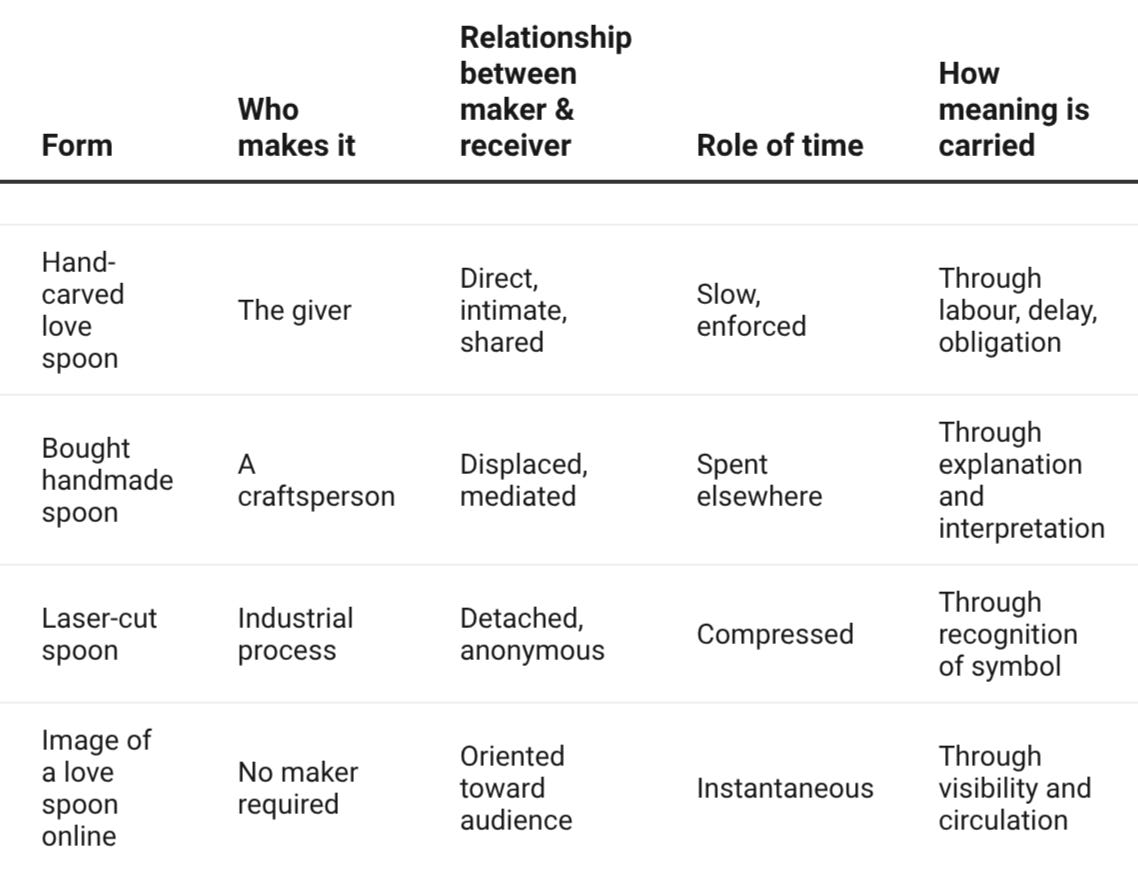
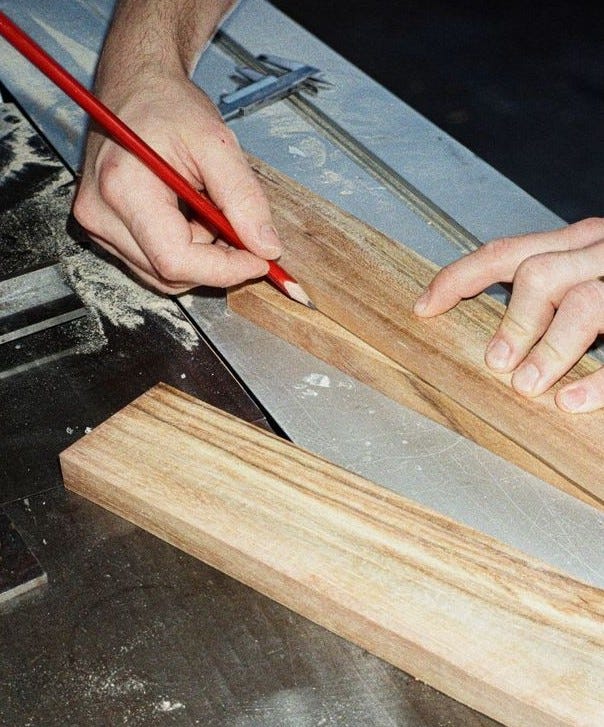
Laser-cut spoons are not a poorer version of the tradition. They belong to a different logic altogether. Nothing in their production requires touch. Instead the commercial availability replaces inheritance. The form survives intact, but the conditions that once gave it weight are no longer present even in displaced form. The question is not whether using bandsaws or machines, as opposed to hand carving cheapen the love spoon, but whether the tools in use still enforce delay, or simply remove it, leaving the object intact while severing it from the unrepeatable time of its making.
The image of the love spoon now circulates more widely than the practice ever did. It appears on postcards, tea towels, institutional branding, social media posts. It signals a shorthand for Welshness without requiring daffodils and/or dragons. As a symbol, it works. As a practice, it’s funeral was decades ago.
This shift is not accidental. It corresponds to a broader reorganisation of everyday life under conditions where time is fragmented, and the work of sustaining relationships and culture is increasingly privatised. Under such conditions, practices that depend on shared duration become harder to maintain. Symbols persist because they require less coordination. They survive because they are easier to live with.
What has really changed is this: the love spoon once helped create a relationship through time. Now it signals a relationship after the fact.
The carved love spoon did not merely express a relationship; it helped bring one into being by reorganising time around it. The contemporary spoon arrives after the relationship has already been named. The work of establishing connection has shifted elsewhere, or inward, or has been left incomplete. Intimacy is no longer organised through shared process, but through acts of recognition that arrive once the relationship has already been named.
The love spoon no longer interrupts time. Meaning arrives compressed into the moment of exchange. What once accumulated gradually is now concentrated at a single point at a shop till or given to you by a postman. It’s important to note that technologies of speed don’t necessarily erase meaning; they make duration harder to defend.
In the same way that care has not disappeared. It has been reorganised. Gestures are asked to compensate for the absence of shared structures. They are expected to do what routines, thresholds, and collective time once did. This is why gestures feel heavy, and why you might get accused of ‘love boming’ for giving a love spoon before establishing the boundaries of the relationship on the allocated waiting time the algorithm has decided. Romantic gestures are not excessive; they are burdened.
I guess what earlier forms of delay also provided was protection. Delay spread expectation and slowed anticipation. It gave relationships somewhere for disappointment to settle without collapsing inward. When delay disappears, meaning does not become weaker; it becomes more volatile. What had once been absorbed by process is now felt directly, without buffer. This volatility reshapes how effort itself is perceived. In the absence of shared thresholds, effort itself becomes risky rather than reassuring. And that gesture can either register as care or as intrusion, generosity or as pressure.
Making still exists, but it no longer organises how people take part.
Buying is no longer an alternative to making; as it is now the only remaining way to participate.
Consumption becomes the most reliable mode of entry. This is not a matter of individual preference. It reflects a narrowing of available ways to participate at all.
Under these conditions, passivity is not chosen so much as produced. Consumption allows contact without coordination. Recognition allows involvement without exposure. Meaning can be accessed without being sustained.
These forms endure not because they are fulfilling, but because they minimise coordination under conditions of exhaustion. They reduce risk. They lower the demands placed on time. They allow people to signal attachment without reorganising their lives around it. This reshapes intimacy. The unease that accompanies many contemporary gestures is often interpreted as personal uncertainty: a lack of confidence, clarity, or emotional skill. But it is also structural. When shared processes weaken, more is asked of individuals to interpret, assess, and manage meaning on their own. What the love spoon reveals is not a private failure of intimacy, but a collective difficulty in sustaining forms of life that require shared time rather than individual management.
The question of whether a gesture is ‘enough’ or ‘too much’ has no stable answer, because the conditions that once set thresholds have eroded.
In this context, feeling unsure is not evidence of emotional failure. It is a reasonable response to a situation in which meaning must be assembled privately, without the support of routines that once made such assembly less precarious. What appears as individual anxiety often reflects a wider thinning of the social ground on which relationships are built.
When there is little shared process to absorb strain, more weight is placed on interpretation. The moment must hold what the process once did. Disappointment has fewer places to go. Meaning settles unevenly, or not at all.
Meaning is increasingly assembled in the self, even as the conditions that once sustained it collectively weaken. The language of choice fits easily here. Autonomy becomes the measure of freedom, even when the range of available choices is shaped by exhaustion, precarity, and isolation. Choice names how people endure these conditions, but it does not alter them. It describes survival without redistributing the burden.
The love spoon now functions less as a living tradition than as a headstone. Not an invitation to recover what was lost, but a marker of a form of making that can no longer be widely practised. Its presence does not signal continuity. It marks an ending that remains culturally visible. What disappears with the loss of delay is not symbolism, but presence. The carved spoon once carried the trace of a specific time spent, a time that could not be recovered or repeated. Its meaning was inseparable from that irreversibility. What circulates now is the image of that presence, detached from the conditions that produced it. The form persists, but the encounter it once staged does not.
This condition is not unique to the love spoon. It appears wherever symbolic forms outlast the practices that once sustained them. As everyday cultural reproduction becomes uneven and fragile, representation expands to compensate. Objects and images are asked to stand in for processes that no longer reliably organise daily life. Symbols proliferate not because they are empty, but because they are among the few cultural forms that still travel easily under conditions of fragmentation.
There is an assumption beneath much cultural mourning that deserves interrogation: that practices must be reproduced, and that meaning must endure through time, labour, and continuity in order to remain valid.
This has never been universally true.
We mourn the loss of continuity even as we quietly rely on its absence to keep life manageable. Some forms of meaning have always operated through immediacy, recognition, and display. What is distinctive now is how much meaning is forced into these forms because other supports have weakened.
The shift is not from meaning to meaninglessness, but from shared meaning to privately managed significance.
If you forgot about Diwrnod Santes Dwynwen, this is a reminder that Valentines Day is round the corner… if you end up buying a laser-cut spoon at the last minute, it will still mean something.