
Language Is Not a Worldview
Why difference survives symbolically while inequality persists.

The belief that different languages produce different ways of understanding the world is rarely presented as an argument. It is offered instead as something closer to common sense. Languages are said to carry distinct outlooks, alternative relationships to time, authority, or place. To learn a language, in this telling, is not simply to acquire a means of communication, but to enter another reality.
What matters here is not whether languages feel different to speak. They clearly do. What matters is whether claims about linguistic worldviews explain how power, access, and persistence actually operate. Do these claims help us understand who gets heard, who is taken seriously, and why some ways of speaking move easily through the world while others do not? This is the limit against which the belief has to be tested. On that test, it begins to fail. What is at stake is not meaning, but durability: which languages continue to function as shared social infrastructure, and which are left carrying symbolic weight without institutional support.
The appeal of the worldview claim lies in what it promises. It offers a way of valuing difference without confronting the conditions that shape it, allowing struggle to be relocated into meaning, where it can be affirmed symbolically, avoiding having to be organised, contested, and sustained. This is not an innocent misunderstanding. It is a displacement.
A simple test makes this visible. If languages genuinely produced different realities, moving between them would involve fracture. Experience would not line up. Memory would resist translation. The world would feel discontinuous. This is not what bilingual or multilingual life looks like. What changes instead is effort: how smoothly someone can move, how much explanation is required, how much friction appears when trying to be understood or taken seriously.
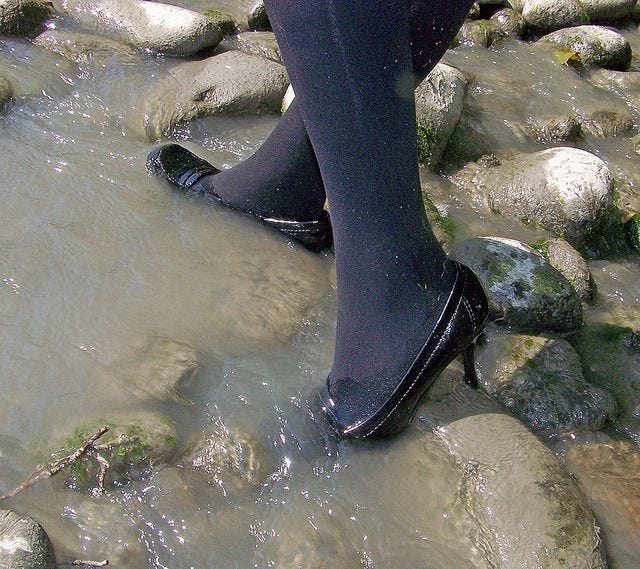
Cymraeg has the word socsan: the experience of getting your sock wet. English has no single word that performs the same task. A non-Welsh speaker will need a phrase. But the experience itself arrives in exactly the same way. Nothing about that sensation waits for language in order to exist.
This is the point at which the explanation breaks down.
A word does not create the experience. It gathers it. It allows recognition without elaboration. Language organises experience after the fact, reducing effort. It does not generate a different world.
Over time, this organisation can sediment habits of expression, but it does not introduce new sensations, needs, or relations into existence. Claims about linguistic worldviews erase this distinction. Ease of expression is mistaken for depth of perception. What can be named quickly is treated as what can be known more fully. The absence of a single word is taken as evidence of a missing concept …for hiraeth: see longing.
Essays announcing “untranslatable” words reappear regularly, usually framed as discoveries about perception, when what they register is not the absence of experience but distance from the conditions in which that experience is routinely named.
This is not an argument that language does not matter. Language does not alter what exists, but it powerfully mediates how people are positioned, evaluated, and disciplined within existing structures. It affects who sounds authoritative, who appears confident, who is assumed to belong, and who must justify themselves. Confusing this mediation with the creation of reality is precisely the mistake the worldview claim makes.
Bilingual experience makes this harder to ignore. Switching languages does not fracture reality. It reveals hierarchy. Some languages pass through institutions with little resistance. They are assumed, authorised, already legible. Others treated as supplementary.
This is where the worldview claim quietly changes function. What presents itself as a description of perception becomes an explanation for inequality. Difference is treated as something generated internally, not structured externally. Language is asked to explain what only institutions can sustain.
English’s position makes this visible without exaggeration. English does not dominate because of its grammar or expressive range. Other languages have more speakers. Other languages sustain vast cultural worlds. What distinguishes English is its historical position within systems that operate at scale: markets, research, professional legitimacy, state administration. Language did not create these arrangements. It was drawn into them, carried by them, normalised through them. Over time, repetition does its work. What circulates widely begins to feel neutral. What moves without resistance starts to appear natural. Power becomes background, and background becomes explanation.
In Wales, this dynamic is often misread. Almost every Welsh speaker also speaks English. Learning Welsh does not open a sealed communicative world running alongside the dominant one. It does not grant access to a separate reality. What it changes is the terms of participation in particular settings, and the forms of recognition available there. Economic arrangements, political decisions, and media flows continue regardless.
This is where cultural discussion often stalls, mistaking a change in relationship for a change in world. And the point at which explanations turn to grammar. Welsh does not rely on a simple equivalent of ‘to have’ in everyday speech. Possession is expressed through relational forms: dwi efo car, mae gen i gar. From this, it is sometimes concluded that Welsh speakers have, or once had, a fundamentally different relationship to ownership.
The appeal of this idea is obvious. It offers a way of locating resistance deep in language itself, beyond the reach of institutions. It suggests that something essential survived intact.
But lived experience tells a less reassuring story. When someone says dwi efo car, (literally “I’m with a car”) they are not suspending the idea of ownership. They understand the phrase as possession because the social world they inhabit has already fixed its meaning. Insurance, liability, regulation, and market relations do not dissolve in the presence of grammar.
Welsh history was not organised outside power. Welsh-speaking societies developed structured systems of landholding, obligation, inheritance, and status. Authority was exercised through these arrangements. Conflict and exclusion were handled within them. These forms limited some kinds of accumulation and enabled others, but they did not remove hierarchy or disagreement. Difference in social form does not point to a different moral order. Readings that treat language as the container of an intact alternative ethics mistake a particular way of organising life for a timeless value, and confuse modes of expression with the arrangements that made them workable.
This is why vocabulary is revealing, though not in the romantic way it is often presented. New words tend to appear when social relations harden into something routine and enforceable, when they become abstract enough to require constant reference. Vocabulary follows consolidation, it does not announce a sudden shift in consciousness. Power can be lived for generations before it is abstracted into daily speech.
Each of these cases fails in the same way. Grammar is asked to explain relations that are stabilised elsewhere.
The idea that language shapes how people understand the world is often traced to the Sapir-Whorf hypothesis. When it emerged in the early twentieth century, it functioned less as a claim about cognition than as an intervention into hierarchy. It asserted that speakers of different languages were coherent rather than deficient, countering biological racism by relocating difference in culture and thought. In that context, the claim mattered. What it did not do was alter the material conditions under which languages were suppressed, territories were reorganised, or labour was controlled. As the hypothesis lost ground in linguistics, it persisted elsewhere. In cultural and heritage discourse, it hardened into common sense, offering a way to defend dignity where institutional power was absent. Difference was preserved symbolically, while the structures that produced inequality remained intact.
The belief that language shapes how people understand the world emerged at a moment when explaining difference mattered politically. It challenged biological hierarchies by insisting that speakers of different languages were not deficient.
But by locating difference in language and thought, it also offered an account of inequality that could leave dispossession, political exclusion, and economic domination untouched. As this idea migrated into cultural discourse, it took on new work.
For communities whose institutions have been eroded or closed, symbolic depth can become a survival strategy. Calling this a survival strategy does not make it trivial; it explains why it works. For many minoritised and oppressed languages, far more vulnerable than Welsh, meaning is sometimes all that remains when material support, governance, and security are absent; language becomes a site of self-defence. The problem emerges when this defensive function is mistaken for a sufficient account of why marginalisation persists, or how it might be undone.
Letting go of the worldview claim does not just remove an explanation. It removes a form of comfort that has stood in for protection. The appeal is not that language creates another world. The appeal lies in the fact that it allows people to feel politically active without confronting what they cannot currently change.
What work are we asking language to do when we stop asking institutions to change?
This is not an argument against culture or language, but against asking them to do work they cannot sustain. Abandoning the worldview claim does not leave emptiness. It exposes the scale of work we were hoping to avoid.
Language matters because people matter. It carries memory, humour, habit, care, and conflict. It holds density because people hold density, not because grammar encodes an alternative reality. Treating languages as separate worlds flattens them, cutting them loose from the social conditions that give them force.
Any argument that relies on language to do the work of institutions will fail in exactly the same way the belief itself does.
This challenged my own (lazy?) acceptance of the ‘language shapes reality’ view, and such well-argued challenges are always welcome. So I will think twice in future about accepting it uncritically.
Diolch yn fawr.