
Mapping the Peri-Peri Periphery
From Nando’s to Bronglais, this essay traces how peripheralisation makes distance part of ordinary life in rural Wales.

There’s a map that floats around online every so often, the one showing how far you’d have to travel to reach the nearest Nando’s. It’s meant to be mildly amusing, but you can practically hear the peri-peri sauce of social commentary bubbling underneath.
I never really managed to scroll past it. Reddit called it one of those ‘extremely important data maps.’
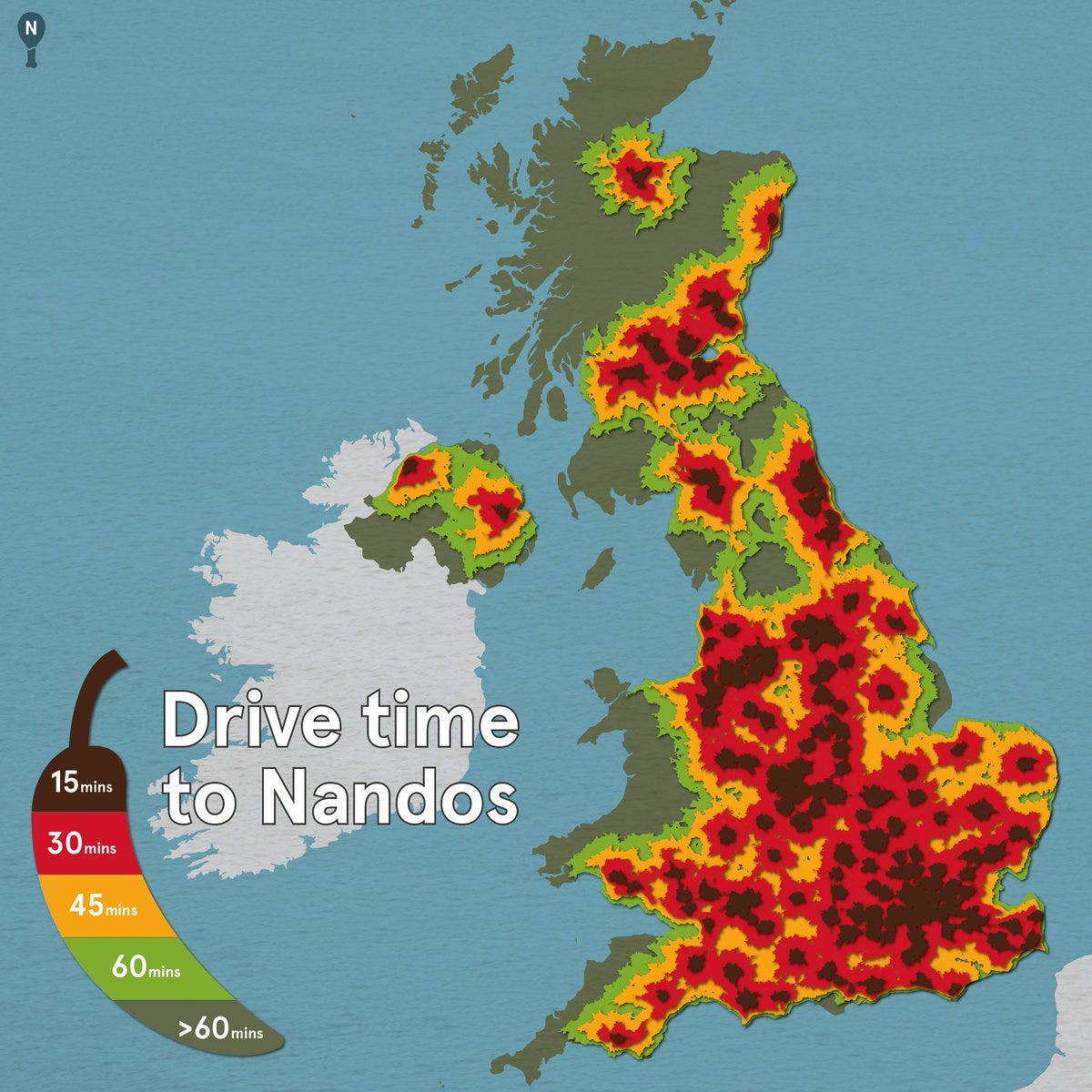
It looks light, but it works as a kind of heat map for how easily things settle. Red gathers around cities, pale green spreads out, drive times stretching in slow gradients. I took a screenshot. What stayed with me was how some places seem to collect things, while others are left to stretch themselves thin at the edges.
If you grew up in one of those pale zones, you don’t need much time with it. You recognise it straight away. It isn’t analysis; it’s a diagram of how things have always been arranged.
A throwaway map like this is more honest than any glossy government brochure. No need for a legend or a mission statement. It just shows where ease gathers and where it doesn’t. Something you already lived inside gets traced out in front of you, as if the obvious needed a diagram.
I grew up in north-west Wales. Not in the middle of nowhere, but far enough out that distance was always part of how things were arranged, what you did, how often, whether it felt worth it. The local Primark was a six-hour round-trip to Chester, usually an annual January event to raid the sales.
The nearest cinema required a minor odyssey: Cineworld, Llandudno Junction, just off the dual carriageway, far enough to change how often you went. Two buses: the 62 from Amlwch to Bangor, about fifty minutes, then the number 5 to Llandudno Junction, another fifty. Unmatched timetables meant that if you missed one, you just hung around the metropolis that is Bangor City.
The internet changed that. Rather than altering your location, it made comparison inescapable, creating a new sense of proximity to things once out of reach.
I was about fourteen when Tumblr started to fill things out. Other people’s lives appeared in fragments. American Apparel skater skirts. Starbucks Frappuccinos. Hollister bags. Coffee cups as modelling props. These were objects pretending to be background, close enough to the person taking the photo that they didn’t need to think about them.
When scrolling, you start noticing small things. The smallest habits. The way people move through their day. The fact that they don’t seem to be calculating all the time. Things are just there, close enough to be taken for granted. It’s not that those lives are better; they are just arranged differently.
What changes isn’t just what you see, but how often you see it. The comparison doesn’t announce itself as a comparison, because the object of want dissolves into environment. You don’t have to go anywhere to feel elsewhere as it runs alongside everything.
If someone tried to write The Country and the City now, the contrast would appear immediately, without waiting for a move; constant digital refreshes would ensure it is always present. It changes the tempo of noticing. You don’t need to leave to feel out of place. Elsewhere sits in your hand, making where you are feel slightly self-conscious.
I remember getting Starbucks for the first time in 2012 on a school trip to our closest synagogue in Liverpool. I’d seen it constantly online. Cups in hands, on desks, in cars, always just there. Not special. That was the point. It belonged to a life practised in presenting itself. Iced, with a tower of whipped cream on top. I wanted the photo as much as the drink. You know what says you’ve left the bubble, even if only for a few hours, even if it is on a school trip, and that part is strategically left out. This moment occurred before social media feeds turned polished and curated. Back then, the significance was just the small act of access. I was somewhere else. I had reached the thing. For a moment, ‘civilisation’ arrived in a plastic cup with syrup and whipped cream.
The drink disappoints, while the wanting continues. The feeling comes first, its explanation catching up later. By the time you explain it, you’ve already felt it a hundred times. The excitement was never in the drink or the sharing of the photo. It lived in the gap between the life I lived and the one I learned to want. There was a point where getting ‘cheeky Nando’s’ meant something similar, RIP 2010s internet culture.

It’s never only about the food. I still catch myself wanting the signs, not the chains themselves. More of the feeling attached to them.
I notice it when I visit Cardiff. Arriving with a list of things I can finally do in one place. Try on glasses from a shop that doesn’t exist at home. Swatch makeup instead of guessing online. Pick up something without having to build a day around it. Nando’s as infrastructure theory; Harvester as political economy; all-you-can-eat salad in the world’s smallest bowl as a map of uneven development. It’s easier to picture a Nando’s than a bus that reliably arrives, easier to desire a Starbucks than to imagine a place where access isn’t set by numbers or footfall. These small features stand as emblems for something larger, even if you can’t define it.
I could create other versions of the same map in Canva myself. Toby Carvery. Harvester. Clustered along the M4, then absent across most of Wales. Not scattered. Just gone.
In our first semester at university, a friend of mine from Newport couldn’t quite believe I had no idea what either of them was. Not that I hadn’t been. It was more than the names didn’t carry anything for me. No image. No smell of carvery gravy. No memory of being taken there by someone’s parents. No sense of a birthday meal, a Sunday, a retail park, a bowl of salad that somehow seemed designed to prevent abundance. (We did have a Pizza Hut in Llandudno Junction with the all-you-could-fill ice cream bowl, so don’t feel too sorry for us north Walians. Civilisation had reached us in some forms, just not always the ones other people assumed were universal.) She drove me to one eventually. I remember less about the food than the feeling of the place already existing somewhere in my head, even if it hadn’t meant anything before. The menus, the plates, the soft familiarity of it. It wasn’t unfamiliar, just already set up. Like going back to a room at a house party after getting another drink, realising the conversation has already moved on.
Of course, the absence of a Nando’s is no index of vitality. It just means that particular model doesn’t expect enough from it: enough passing trade, enough repeat spending, enough density, enough movement arranged in the right way.
A chain restaurant’s profitability calculations are its own concern. More interesting, however, is when these same calculations appear in other areas. Chain restaurants don’t invent these logics; they simply make them visible.
At what point does a map of expected customers start resembling a map of expected patients, expected passengers, expected investment, expected futures? Or expected residents… The same geography appears in housing. Some places become easier to visit than to remain in. What does a place become when it is easier to consume than to participate in?
I feel this more clearly now in Aberystwyth, without a car. Not as some big crisis. More in the small assumptions underneath the day. Job listings that expect you to drive. Events that finish after the last useful bus. Meetings that assume leaving is simple.
There are places that aren’t far away on a map, but feel much further once you have to reach them through timetables. The national park isn’t impossibly distant. That’s almost what makes it annoying. It’s close enough to think about going, far enough that it becomes a plan. You don’t really just pop somewhere on the bus. You check the times. You think about connections, daylight, how long you can stay, and whether getting back will become the main event.
In Aberystwyth, a university town, the calculation begins before plans are drawn up. From some angles, it feels like a centre, but distance still shapes everything.
There are evenings when the light goes slowly over the sea, and everything feels briefly suspended. You don’t need to be anywhere else. You’re just there. Then the town closes in slightly. Not because anything has happened. Just because the routes have quietly been reduced.
It isn’t about what’s technically possible, but about what repeats often enough to shape the week.
You stop noticing some of the calculations. They become part of getting around. You know which bus routes work, which connections don’t, which events are possible and which probably aren’t unless you leave early. The calculation itself becomes part of being realistic, and competence starts to look a lot like adaptation.
Sometimes I find myself on more international calls than local events. The local is supposed to be the thing that’s close at hand. Yet there are weeks when people in Dublin, Cornwall or Copenhagen feel easier to reach than somewhere forty minutes down the road.
At some point, you start noticing that this doesn’t stop at the level of the UK. It happens inside Wales too. Cardiff and the M4 corridor concentrate things; elsewhere, they stretch. Aberystwyth feels lively, but can’t stop things slipping elsewhere.
World-systems theory gives a name to the relation the map has been showing all along. A core is not just a place with more things in it. It is where routes, money, services, decisions and confidence are organised to gather. A periphery is not simply far away. It is included differently.
Peripheralisation is the process that keeps remaking that relation. It is why a place can be connected and still feel structurally out of reach. Why things arrive late, leave early, or stay in name while their authority moves elsewhere. Why the same journey can be treated as reasonable from one end and exhausting from the other. That is what the Nando’s map catches by accident.
That becomes harder to ignore when the same logic shows up around Bronglais. This is where the map stops being so lighthearted. The same general pattern applies public services too, what stays local, what gets moved out, and who is expected to absorb the distance?
Bronglais Hospital is in Aberystwyth. It serves Ceredigion and a wide rural area across mid Wales. That geography matters before anything else has even been said. Distances that look manageable on paper feel different when you are ill, waiting, dependent on someone else’s lift, or trying to work out how your family will visit. The current argument around Bronglais is about stroke services. Under the preferred proposal being consulted on, specialist acute stroke care would be centred at Glangwili Hospital in Carmarthen. Bronglais would still see suspected stroke patients at first. It would still have stroke rehabilitation. But patients needing the specialist acute unit would be transferred out of mid Wales to Carmarthen.
That is the point. A service can remain local in name while its decisive capacity moves elsewhere. This is not abandonment in the simple sense. That would be easier to name. Bronglais remains. The building remains. Some treatment remains. Enough remains for the service to still look present from a distance, but the centre of gravity shifts.
That is how peripheralisation often works. Not through one dramatic removal, but through reorganisation. A hospital stays open, while more of its specialist capacity is pulled towards a larger centre. The place is still included in the system, still expected to cope, still described as served. But more of the authority over care sits elsewhere. The decision doesn’t arrive looking like a decision. It comes as adjustment, review, pathway, centralisation, efficiency, and by the time it becomes part of ordinary life, it has already happened somewhere else.
After Bronglais, smaller things start to look different again.
Activist friends organise events in London because it is “easier for people to reach.” The fact that that sentence makes sense for so many people is part of the problem. From Aberystwyth, London is nearly 6 hours by train if everything goes smoothly. If the train turns up. If the connection holds. If the morning service has not been replaced by that strange announcement about a “lack of trains,” which sounds less like a delay and more like someone describing the whole country by accident. You don’t decide not to go all at once. You just start knowing you probably won’t. The plan is filtered before it becomes a plan. After a while, you stop looking.
In This Country, Kurtan plans a trip to TK Maxx like it’s a logistical operation. The accuracy is painful. It shows something about reach. You’re not completely cut off, yet far enough out that certain things don’t arrive, or don’t stay, or require enough effort that they stop being part of ordinary life.

 Tiktok failed to load.
Enable 3rd party cookies or use another browser
Rural life costs more than people admit. Not in some romantic sense, but in practical terms, mostly time. The effort doesn’t vanish when infrastructure is cut back. It just gets transferred onto you. You start losing things before you have decided not to do them. A journey, an event, a visit, a plan that would have needed too much working out. There is another side to it. People come to places like this for the quiet, for the slowness, for the absence of things. It’s easier to enjoy when you are not relying on it. The same condition can feel like escape to one person and a narrowed week to someone else.
I don’t want to leave. Not entirely. I don’t want this unchanged either. I don’t want a Nando’s in every town, or a Wales remade as one endless retail park with a slightly improved bus stop. But I also don’t want the kind of local distinctiveness where the price of difference is having to plan everything three days ahead.
The thing I want is difficult to picture because it isn’t an object. Which is probably why a map of chicken restaurants ended up carrying so much weight.
The map lingers because it wasn’t trying to say any of this. It was just light enough to be useful. A joke about chicken that ended up tracing the outline of something else. I know it isn’t about the chicken. I also know that knowing this doesn’t stop me wanting what the chicken seems to stand in for.
Anyway…
What Nando’s sauce do you usually go for?
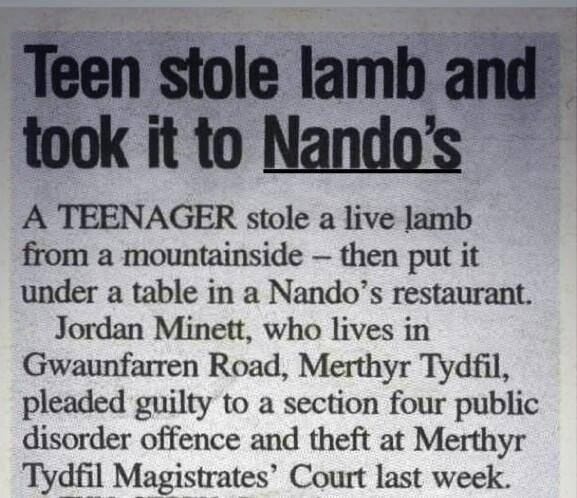
Read this and remember how as a 90s kid (in rural Carmarthenshire) the idea of getting a take-away pizza delivered felt very modern and exciting, because it did not exist near me. Part of me still feels like that when I get a take-away delivered 30 odd years later!
Cofio deffro am 5 yn bora er mwyn codi digon buan i ddal 3 bws o Glynnog i Gaernarfon, o Gaernarfon i Bangor ac o Fangor i Llandudno Junction er mwyn gweld ffilm yn Cineworld ryw ddydd Sadwrn yn 2015. Poenus